A case study to ponder
Imagine a university where the quirky love of chickens was part of the curriculum. Consider Pitzer, in California, and its president, Laura Trombley.
Although I have written on Virginia Woolf, while her focus is Mark Twain, we share a hermeneutics.
Not of the hermeneutics of suspicion (though we both suspect our object of concern is everywhere), nor the hermeneutics of faith (though we are definitely believers in our object's revelatory powers), nor even the hermeneutics of the subject (although we're both clearly prone to muddle the featherless bipeds of Plato and Diogenes).
No, we share the hermeneutics of chicken poop. We've learned from Latour, moreover, and we know it's not a case of fact. Of course chicken poop exists: on our shoes and boots, on our walkways, and definitely on the occasional egg that we bring in from the nest in the evening. No, for us, the hermeneutics of chicken poop is one of concern. What can it teach us, how do we learn it, from whom do we learn it, what is the importance of what we learn, and most of all why should we be open to learning it?
Take Laura Trombley's case study in the hermeneutics of chicken poop. Pitzer has a chicken coop, near its organic garden, behind the student center. Let's stop here to savor the wisdom in this: chickens to fertilize the organic garden, organic garden to feed the students (body and mind), students to feed the chickens and in turn to feed themselves (mind and heart). A visiting student (the messenger of wisdom from afar) emails President Trombley to tell her: Your chicken is sick. Can Scripps students know what Pitzer students do not? President Trombley swings into action, and consults an expert--their resident 'chicken whisperer,' who reassures the President, and she in turn reassures the student, that it's a simple case of dropping feathers. (Diogenes' chicken approximating Plato's man?)
The Scripps student challenges President Trombley, who is after all not her President. And she marshals facts to support of her case: two photographs taken at the scene of the coop, showing the runny butt of one chicken and the clean control butt of another hen. The hermeneutics of poop can now be employed, and President Trombley does so, at the staggering cost of one hundred dollars to "get the chicken fixed."
I draw two conclusions from this lovely story. Take it as a case study in knowledge production. It teaches us a number of things worthy of our concern: listen to outsiders, don't always trust experts, and above all don't assume that colleges (and college presidents) are above dealing with things as messy, runny, and hard to define as chicken poop.
Then take it as a case study in the gendered production of knowledge. Note that the president and her outside informant are both women, women who trust each other and trust the evidence right in front of their eyes, even when it contradicts expert opinion. The president even trusts her mother not to embarrass her when she comes for campus visits. Instead, she welcomes her mother, even letting her see her office and her computer, where those two photographs of chicken butts are displayed.
President Trombley clearly feels no contradiction between her little girl past and her presidential present. And why should she? She's comfortable with this foray into the hermeneutics of poop. As she tells her mother:"It's all part of being a college president."
Now if we can only get other college and university presidents to the same level of understanding. Just as studying chicken poop is part of being a college president, so studying chickens, and organic gardens, and the messy uncategorizable knowledges and practices tying them together, should be part of being a college student. Okay, a quirky one.

Showing posts with label organic farming. Show all posts
Showing posts with label organic farming. Show all posts
Friday, February 11, 2011


Saturday, December 4, 2010
Poultry Slam
Well, Ira Glass and his crew on This American Life have for several years been providing company--even fellow-feeling--as I have researched and written about chickens. That experience continues now that my book is in print. My "Culture" chapter compares the chicken portraits of Jean Pagliuso's show "Poultry Suite" (a show at the Marlborough Gallery in New York) to the genre of breed portraits stretching from Charles Darwin's colleague Tegetmeier to the American Standard of Perfection (the handbook for chicken exhibitors).
I wasn't completely surprised, then, to find that this year's Poultry Slam also considers the poultry portrait. In one of the four stories, Ira Glass interviews Tamara Staples, a poultry photographer from Chicago. Glass's commentary explores different perspectives on that classic text of chicken exhibitors, The American Standard of Perfection. Give it a listen: http://www.thisamericanlife.org/
During that same story, Ira interviews a chicken breeder. "In the country, among the chicken breeders, you think about a lot of things you never get to in the city," Ira opines. And then the eighty year old chicken keeper tells Ira about how he treated his own cancer by using "the root of the dandelion." "He's got no hard scientific proof that this really works" Ira acknowledges. Well, looking for "hard scientific proof" of old folk remedies is another one of the epistemological backflips industrial pharmaceuticals are rounding back to, just as industrial poultry farming is has decided to return to producing the so-called "natural" chicken. See the new product from Cobb-Vantress, the "Cobb Sasso 150": http://www.cobb-vantress.com/Products/CobbSasso150.aspx
In Global Nature, Global Culture, Sarah Franklin, Celia Lury and Jackie Stacey explore the power that "nature" holds as what they call a "shifting classificatory practice." They are talking about rhetorical power, among other things. This is the persuasive power packed into the term "nature" that can lead a major pharmaceutical company to prospect for potential new products in the jungle (see Londa Schiebinger's Plants and Emllpire: Colonial Bioprospecting in the Atlantic World). Or Cobb-Vantress to launch their new product line, the "Cobb Sasso 150" specifically bred, they explain, to meet the consumer preference for "slower growing, colored chicken."
Classification is at work in other ways in the Cobb-Vantress website. Note the choice of the label "chicken" in the phrase above. Despite their claim to honor "traditional free range and organic farming," their commitment to the creation of a quality controlled product is showing here. Slower growing, and 'colored' perhaps, but nature still seems to an elusive property of this new breed, which they categorize not as chickens, the species, but as chicken, the category of meat. Nature denatured, as they observe in GNGC: an intentional object always already denatured through its industrial production.
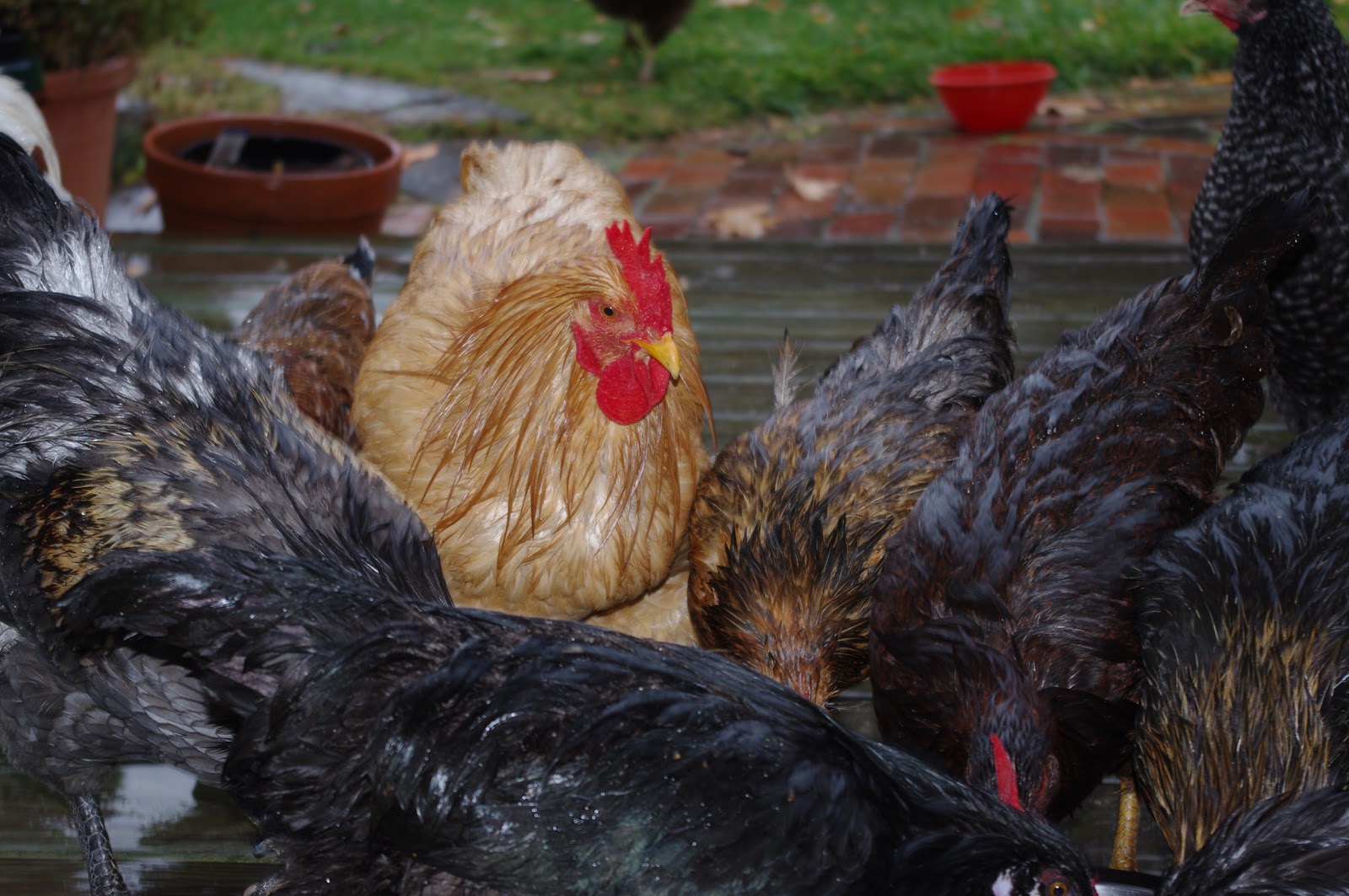
 And of course there is the fact of human intervention in that shifting classificatory practice known as breeding. Here is one of my current favorite chickens: the Giant Cochin that Murray McMurray sent me as a "surprise chick."She truly is as much bigger than the other birds as she looks in these photographs. The "Biology" chapter of PSCC tells the tale of the boom-and-bust impact produced by the the importation of Cochin chickens from China in the nineteenth century.
I wasn't completely surprised, then, to find that this year's Poultry Slam also considers the poultry portrait. In one of the four stories, Ira Glass interviews Tamara Staples, a poultry photographer from Chicago. Glass's commentary explores different perspectives on that classic text of chicken exhibitors, The American Standard of Perfection. Give it a listen: http://www.thisamericanlife.org/
During that same story, Ira interviews a chicken breeder. "In the country, among the chicken breeders, you think about a lot of things you never get to in the city," Ira opines. And then the eighty year old chicken keeper tells Ira about how he treated his own cancer by using "the root of the dandelion." "He's got no hard scientific proof that this really works" Ira acknowledges. Well, looking for "hard scientific proof" of old folk remedies is another one of the epistemological backflips industrial pharmaceuticals are rounding back to, just as industrial poultry farming is has decided to return to producing the so-called "natural" chicken. See the new product from Cobb-Vantress, the "Cobb Sasso 150": http://www.cobb-vantress.com/Products/CobbSasso150.aspx
In Global Nature, Global Culture, Sarah Franklin, Celia Lury and Jackie Stacey explore the power that "nature" holds as what they call a "shifting classificatory practice." They are talking about rhetorical power, among other things. This is the persuasive power packed into the term "nature" that can lead a major pharmaceutical company to prospect for potential new products in the jungle (see Londa Schiebinger's Plants and Emllpire: Colonial Bioprospecting in the Atlantic World). Or Cobb-Vantress to launch their new product line, the "Cobb Sasso 150" specifically bred, they explain, to meet the consumer preference for "slower growing, colored chicken."
Classification is at work in other ways in the Cobb-Vantress website. Note the choice of the label "chicken" in the phrase above. Despite their claim to honor "traditional free range and organic farming," their commitment to the creation of a quality controlled product is showing here. Slower growing, and 'colored' perhaps, but nature still seems to an elusive property of this new breed, which they categorize not as chickens, the species, but as chicken, the category of meat. Nature denatured, as they observe in GNGC: an intentional object always already denatured through its industrial production.

Subscribe to:
Posts (Atom)