Wednesday, February 15, 2012
Miss Nancy Luce, a Vineyard perspective
Friday, September 2, 2011
Another augury
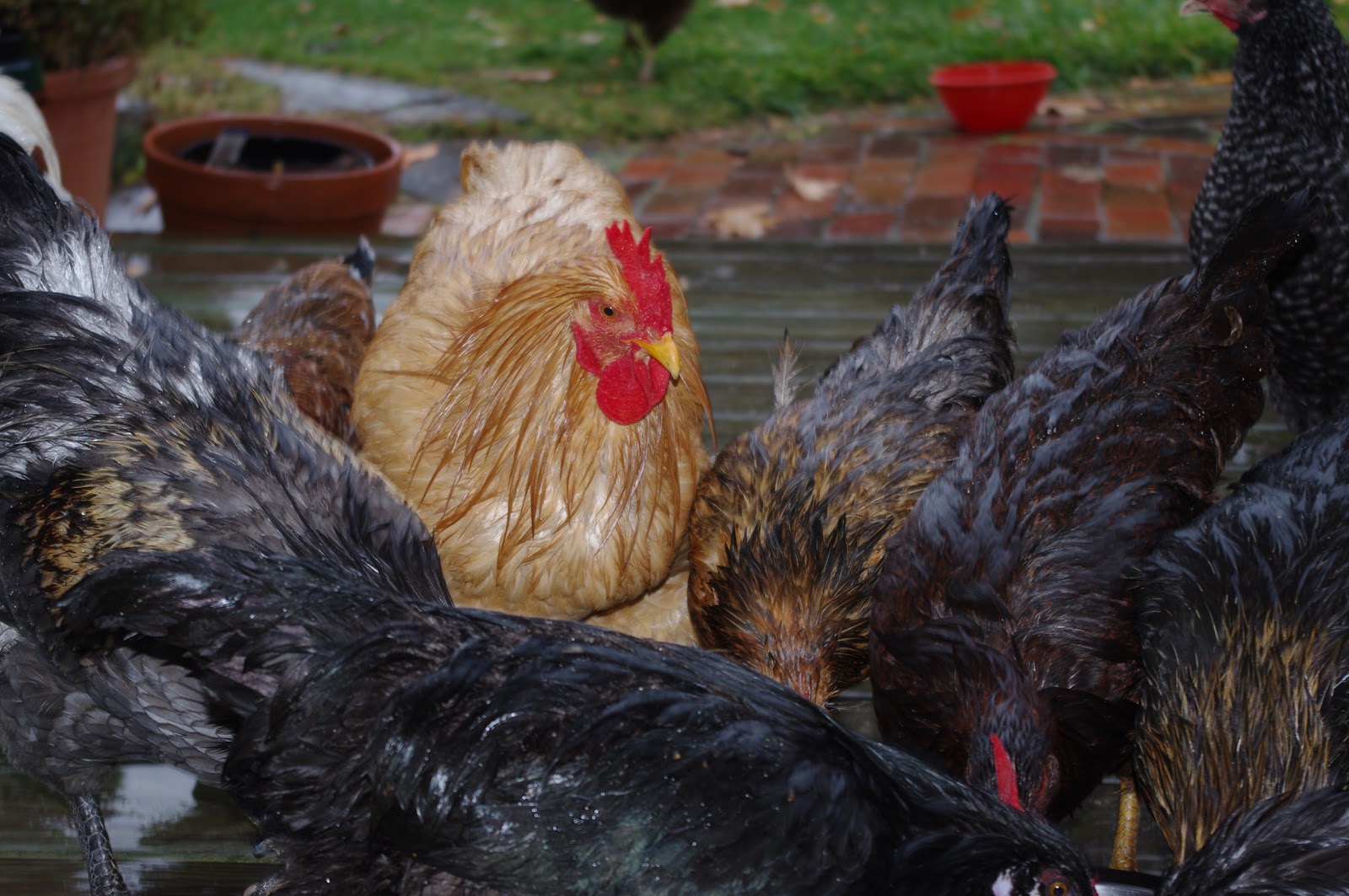
This is why we have roosters, we said to each other: to keep the hens safe. And this, just before the weekend when we had decided both roosters had to go . . . . They've ridden our hens so hard that several have no back feathers, and one has a bald head.
Pharmakon: that which cures but also kills; that which benefits but also harms. Kill the rooster and cure the hens; kill the rooster, and cure the hens only to have the hawk kill them. Practical ethics in the poultry yard.
Saturday, April 9, 2011
spring changes
Another sign is less exotic: we have an Aracauna hen sitting on five different colored eggs, in the garden shed that we divided up to create a brooding space. They are supposed to hatch tomorrow, when my graduate seminar in the Gender and Science: Reproduction class comes over, along with seven students from the Center for Reproductive Biology and Health (between the College of Agriculture and the Huck College of Biosciences) and their lab head, Professor Joy Pate. My students shadowed Joy's students in the lab, or in the barns, or in the field, and tomorrow they will present the results of their shadowing to those they shadowed. And then (I hope) there'll be the opportunity for conversation and feedback from the lab scientists. What a great thing it would be to celebrate the event by having a hatch of chicks!
The final sign of spring for the hens and roosters will arrive in two weeks or so, though I ordered it yesterday. They are getting a new hen house, made by our friends Stolzfus in Madisonburg. It's splendid: on stilts,with nesting boxes that open from the outside, a number of roosts, and windows for aeration. The plan is to shift the birds to this as their summer house, so that we can then clean and air out the winter house, and clean up (of all the scattered shavings from the hen house floor) and seed (with oats or some other edible cover crop) the land all around the winter house. So: clean new home, another spring sign.
As my friend said to me, "So the obsession with chickens doesn't end when the book is published." Absolutely, evidently, not.
Friday, February 11, 2011
A Tale of 2 Chickens, a President, and Her Mother - Postcards - The Chronicle of Higher Education
Imagine a university where the quirky love of chickens was part of the curriculum. Consider Pitzer, in California, and its president, Laura Trombley.
Although I have written on Virginia Woolf, while her focus is Mark Twain, we share a hermeneutics.
Not of the hermeneutics of suspicion (though we both suspect our object of concern is everywhere), nor the hermeneutics of faith (though we are definitely believers in our object's revelatory powers), nor even the hermeneutics of the subject (although we're both clearly prone to muddle the featherless bipeds of Plato and Diogenes).
No, we share the hermeneutics of chicken poop. We've learned from Latour, moreover, and we know it's not a case of fact. Of course chicken poop exists: on our shoes and boots, on our walkways, and definitely on the occasional egg that we bring in from the nest in the evening. No, for us, the hermeneutics of chicken poop is one of concern. What can it teach us, how do we learn it, from whom do we learn it, what is the importance of what we learn, and most of all why should we be open to learning it?
Take Laura Trombley's case study in the hermeneutics of chicken poop. Pitzer has a chicken coop, near its organic garden, behind the student center. Let's stop here to savor the wisdom in this: chickens to fertilize the organic garden, organic garden to feed the students (body and mind), students to feed the chickens and in turn to feed themselves (mind and heart). A visiting student (the messenger of wisdom from afar) emails President Trombley to tell her: Your chicken is sick. Can Scripps students know what Pitzer students do not? President Trombley swings into action, and consults an expert--their resident 'chicken whisperer,' who reassures the President, and she in turn reassures the student, that it's a simple case of dropping feathers. (Diogenes' chicken approximating Plato's man?)
The Scripps student challenges President Trombley, who is after all not her President. And she marshals facts to support of her case: two photographs taken at the scene of the coop, showing the runny butt of one chicken and the clean control butt of another hen. The hermeneutics of poop can now be employed, and President Trombley does so, at the staggering cost of one hundred dollars to "get the chicken fixed."
I draw two conclusions from this lovely story. Take it as a case study in knowledge production. It teaches us a number of things worthy of our concern: listen to outsiders, don't always trust experts, and above all don't assume that colleges (and college presidents) are above dealing with things as messy, runny, and hard to define as chicken poop.
Then take it as a case study in the gendered production of knowledge. Note that the president and her outside informant are both women, women who trust each other and trust the evidence right in front of their eyes, even when it contradicts expert opinion. The president even trusts her mother not to embarrass her when she comes for campus visits. Instead, she welcomes her mother, even letting her see her office and her computer, where those two photographs of chicken butts are displayed.
President Trombley clearly feels no contradiction between her little girl past and her presidential present. And why should she? She's comfortable with this foray into the hermeneutics of poop. As she tells her mother:"It's all part of being a college president."
Now if we can only get other college and university presidents to the same level of understanding. Just as studying chicken poop is part of being a college president, so studying chickens, and organic gardens, and the messy uncategorizable knowledges and practices tying them together, should be part of being a college student. Okay, a quirky one.
Thursday, February 10, 2011
My letter to the Chronicle
I am happy that the Chronicle published my letter protesting the closure of the Penn State STS program. I'm sad, however, that to date it has had few comments and no perceivable effect on the fate of STS at my university. I did, however, have a good conversation with a very committed and interesting young woman teaching STS, nearly as a one-woman show, at another university. I wish her all the best, and hope that together all of us can keep STS a viable option for education. It's not just that we who teach in STS need it. The students in our colleges and universities need it. In fact, in the wake of the Citizen's United decision, our democracy needs it.
STS and chickens
I spent a long time walking around the barn, gathering up the viable eggs, feeding the chickens that were still alive, and collecting the chicks and chickens that had died.
As I said, this is a recurring dream. I have had it during the years I was working on Poultry Science, Chicken Culture, and I have usually understood it as a signal that I was neglecting my writing, or another message from deep in my own unconscious (and like all such messages, overdetermined.)
What happens if I follow my own advice, though, and consider that dream as an augury giving me early warning of the endangered state of interdisciplinary programs like our own STS program. I've learned through keeping chickens that they do indeed come home to roost. And yet what if the roost itself, and the building that shelters it and the chickens roosting there, have been abandoned?
Monday, January 24, 2011
The irony of time
Conspicuously Unconsumed
Pondering Poultry
Susan Merrill Squier answers the obvious question right away, in the introduction: Why chickens? Why, after mining biomedicine, reproductive technologies, radio culture, and, well, Virginia Woolf, did the scholar turn to fowl for her latest book, Poultry Science, Chicken Culture: A Partial Alphabet (Rutgers University Press)?"I gave myself the holiday of curiosity," she writes. The result is a quirky mash of essays on chickens and the interplay of biology and culture that manages to blend all of Squier's interdisciplinary interests. She ranges freely, from takes on chickens as subjects of photography and exhibition, playwriting, film, and children's and other literature, to musings on such public-policy issues as risk management, the avian-flu scare, and the societal costs of industrial agriculture.
"Chickens are good to think with," writes the author—her own flock included.
To our benefit as readers, Squier ignores the counsel of E.B. White, writer, grammarian, chicken fancier: "Don't try to convey your enthusiasm for chickens to anyone else," advice he gave in an introduction to a 1944 poultryman's primer on chicken raising. Squier is sanguine. "I risk my own share of withering glances to admit that I am very partial to chickens—and what we can learn with them, from them, and about them."
At the time of writing, we find out, Squier's own flock numbered 34 hens of various breeds and "three splendid bantam Seabright roosters." Her brood, past and present, tracks busily through the book, adding pleasantly to the lore that leavens the theory.
Saturday, December 4, 2010
Poultry Slam
I wasn't completely surprised, then, to find that this year's Poultry Slam also considers the poultry portrait. In one of the four stories, Ira Glass interviews Tamara Staples, a poultry photographer from Chicago. Glass's commentary explores different perspectives on that classic text of chicken exhibitors, The American Standard of Perfection. Give it a listen: http://www.thisamericanlife.org/
During that same story, Ira interviews a chicken breeder. "In the country, among the chicken breeders, you think about a lot of things you never get to in the city," Ira opines. And then the eighty year old chicken keeper tells Ira about how he treated his own cancer by using "the root of the dandelion." "He's got no hard scientific proof that this really works" Ira acknowledges. Well, looking for "hard scientific proof" of old folk remedies is another one of the epistemological backflips industrial pharmaceuticals are rounding back to, just as industrial poultry farming is has decided to return to producing the so-called "natural" chicken. See the new product from Cobb-Vantress, the "Cobb Sasso 150": http://www.cobb-vantress.com/Products/CobbSasso150.aspx
In Global Nature, Global Culture, Sarah Franklin, Celia Lury and Jackie Stacey explore the power that "nature" holds as what they call a "shifting classificatory practice." They are talking about rhetorical power, among other things. This is the persuasive power packed into the term "nature" that can lead a major pharmaceutical company to prospect for potential new products in the jungle (see Londa Schiebinger's Plants and Emllpire: Colonial Bioprospecting in the Atlantic World). Or Cobb-Vantress to launch their new product line, the "Cobb Sasso 150" specifically bred, they explain, to meet the consumer preference for "slower growing, colored chicken."
Classification is at work in other ways in the Cobb-Vantress website. Note the choice of the label "chicken" in the phrase above. Despite their claim to honor "traditional free range and organic farming," their commitment to the creation of a quality controlled product is showing here. Slower growing, and 'colored' perhaps, but nature still seems to an elusive property of this new breed, which they categorize not as chickens, the species, but as chicken, the category of meat. Nature denatured, as they observe in GNGC: an intentional object always already denatured through its industrial production.
And of course there is the fact of human intervention in that shifting classificatory practice known as breeding. Here is one of my current favorite chickens: the Giant Cochin that Murray McMurray sent me as a "surprise chick."She truly is as much bigger than the other birds as she looks in these photographs. The "Biology" chapter of PSCC tells the tale of the boom-and-bust impact produced by the the importation of Cochin chickens from China in the nineteenth century.
Tuesday, November 23, 2010
STS and chickens
I've just spent five years writing a book on chickens while being a full time faculty member. My book is due out from Rutgers Press this month, and I'm feeling nostalgic for those years in which I shared many of the experiences Jeanine writes about: the pleasures of sitting with the chickens in the morning sun, the challenge of an egg-bound hen, the novice's notion that you have to put the birds back in the hen house at night. (Mine were free to go wherever they wanted during the day--on the lawn, in the fields, in the woods--but after the first night when I tried to shoo them into the henhouse at dusk wielding a broom, I soon learned that they came home all by themselves, lining up in their preferred order on the roosts.) In fact, I enjoyed sitting home with my birds so much, I was really reluctant to step in as the Acting Director of our STS Program. I'd already done administration--been Associate Provost at another university--and was sure I would hate every moment of my return to "the dark side." Instead, I have discovered that I am thoroughly enjoying this brief stint back in the administrative trenches, for much the same set of reasons that I hugely enjoyed writing my book on chickens. Our STS program includes a collection of young faculty members whose interests are as varied as the plumage of my birds: disability studies, food security, sustainable agriculture, embryology, bioethics, Alzheimer's and other cognitive dementias, the history of military technology, climate change, and more. They are united by their conviction that the relationship between science, technology, medicine and society matters, that it shapes our human societies just as we, in turn, have shaped the tools and technologies that conform us as users. These diverse commitments and engagements were also (I am now realizing) what drew me to writing my book on chickens, which I organized as an ABC book so that in each chapter I could explore another aspect of the scientific and cultural interrelationships between human beings and chickens. From Augury, Biology and Culture, to Gender, Hybridity, and Inauguration, I used my focus on chickens to draw me out into the world. And that's just what I am enjoying now about this brief year of directing our STS Program: the engagement with the world in all its complexities that the program's faculty and students share.
So thanks to Jeanine Carr for suggesting another way that chickens help put life--administrative life, this time--in perspective.
Monday, November 22, 2010
animals and ethics
Kaminer's position on this curious new transaction--selecting both the bird for your Thanksgiving dinner and the butcher who will teach you to kill it--is wryly affirmative. She sees it as "all part of the broader cultural effort to escape the climate-controlled, linoleum-lined artificiality of supermarket shopping, in which meat magically appears all ready for your oven and animals are characters in children’s storybooks." Her point makes good sense to me, having spent some time rereading childrens' storybooks when I was writing Poultry Science, Chicken Culture--from the bird's eye perspective on the natural year in Elmer Boyd Smith's exquisitely illustrated tale Chicken World, to the gender-charged Little Red Hen tales of my mother's childhood and my own, and finally to a different kind of globalized vision with disturbingly neoliberal after-effects, in One Hen. In fact, I'd push Kaminer a bit on where the responsibility ends. Just as no bread shows up in the oven without someone to pick the wheat, thresh the grain, lug the grain to the miller, knead the dough, and form the loaves (Little Red Hen taught us that), no turkey arrives on the Thanksgiving table without someone doing the work not just of killing it (which Kaminer did) but of scalding, plucking, and dressing the bird.
We learned this first-hand the day after I finished my book. I was gazing out of the window just in time to see a hawk swoop down from the big tree and kill my Buff Orpington hen. (Yes, she was a little red hen.) I ran out yelling, and found the hawk just sitting there, claws into feathers, staring at me sideways until I ran straight up and forced it to flap up and away. The hen, her neck broken, was floppy, soft, and still warm. (In fact, since chickens have a body temperature of 110 degrees, I mean very warm.)
Now that the hawk had done the deed, it felt wrong just to throw the body of our red hen into the garbage. Stranger in a Strange Land, a book I've never much liked, came back to me: I wanted to grock her fullness (or at least that is the silly sounding phrase I remember from the book all those years ago--kind of a paying tribute by incorporation to a being whose life had worth and import).
So, we decided we would try to prepare her for that ceremonial meal. Having watched our own poultry processor Eli Reiff do the same cone-and-knife procedure that Kaminer learned with her butcher, we knew that we should cut the hen's head off and hold her upside down until the blood drained out. So we did that: Gowen did the cutting, and we tied her legs with twine to the railing of our front deck so that the blood could drain into a bucket below. And then we put a very big pot of water on the stove to boil, while we reread the section on butchering chickens in our Country Guide. Once the water comes to a boil, and hits the right line on the thermometer, you dunk the bird in (holding her feet) and bob her up and down for about 60 seconds to loosen the feathers. So we did that, and then put her on the floor (which we'd covered with a sheet laid down over some garbage bags to keep water off the wood boards). The plucking itself was surprisingly easy; the feathers came off almost as if we were zipping her out of a chicken suit. The 'dressing'--gutting her and pulling out the inner organs, and cutting off the head and feet--came next, and I found that much harder. As he pulled the innards out, we were both shocked when out came a cluster of eggs, from tiny yellow balls to full-sized eggs with shells already on them. I stood near by, but protected by the camera lens, and documented the event while Gowen accomplished it. Result? After the visual shock of the brightly colored innards, the very familiar image of a cleaned and dressed chicken all ready for the freezer.
We stewed the hen, with morels and red wine and onions, and the delicious dinner felt very meaningful, even (I thought at that time) ethical. Yet I return to that now by way of an essay I have been reading written one of my personal heroes--the biologist and epigeneticist C.W. Waddington--in his book The Ethical Animal. Waddington's approach to ethics has a strongly biological basis, yet not in the reductive sense of so much contemporary sociobiology. Instead, he gives us biology in terms that resemble Donna Haraway's essay "Situated Knowledges: The Privilege of Partial Perspective."
"Like all other products of evolution, [the human intellect] has been moulded [sic.] by the necessity to fit in with--or rather, to put it more actively, to cope with--the rest of the natural world. Its function is not to produce a God-like vision of the human situation seen from some stand-point above and outside the turmoil of actual life. The intellect is an instrument forged--perhaps by a rather rough and ready village blacksmith, let us confess--for the specific purpose of coming to terms with things. The situation with which we find ourselves confronted, a world of social-economic revolutions, of wars, of mass scale technology, is the basic raw material by which the intellect is challenged. To discuss subjects such as ethical theory without specific reference to such problems is to run away to an ivory tower. [ . . . ] What is demanded of each generation is a theory of ethics which is neither a mere rationalization of prejudices, nor a philosophical discourse so abstract as to be irrelevant to the practical problems with which mankind is faced at that time." (my italics, Waddington, 1960)
The intellect as a tool, and ethics as a situated theory, rather than a God-like vision from some abstract and unsituated standpoint: this sounds to me like a remarkable anticipation of Haraway's own critique of both standpoint feminism and positivist science, with its "God's eye view from nowhere." Strikingly, at the end of the introduction to The Ethical Animal, Waddington actually suggests that the very word "ethical" might better be replaced with the word "wisdom" which, he says, "remains . . . an aspiration and not an achievement."
Which brings me back to Kaminer's story in the Times. The rueful tone of her conclusion suggests that she has had a brush not with the clarity of ethics, but with something more like Waddington's notion of wisdom. "For those carnivores who are truly at one with the world, killing your own meat might feel almost like a spiritual act, a way to participate in every step of the life cycle. That’s not how it went for me. I found it upsetting and, on some very basic level, gross."
Despite Kaminer's fantasy that an unconflicted wholeness is available to some lucky carnivores, we know that very few people--meat eaters or vegetarians--attain the spiritual elevation of being "truly at one with the world." In its complexity and imperfection, her troubling experience with butchering her Thanksgiving turkey, like our response to the hawk butchery of our little red hen, situates us solidly in the upsetting, even gross, "turmoil of actual life" (to borrow a phrase from Waddington.) To my way of thinking, that's a position well worth our collective thanksgiving.
Saturday, November 20, 2010
Chicken Chicken Chicken Chicken Chicken
Tomorrow afternoon we are throwing a pre-Thanksgiving party tomorrow in honor of the Pennsylvania Association of Sustainable Agriculture, PASA. This local organization helps small farmers to learn to grow food more sustainably, and to market their produce and livestock via the Buy Fresh, Buy Local campaign that they created. It also puts on a large conference every February that draws a national audience, remarkably right in the backyard of one of the major agricultural colleges in the Big Ten.
I've attended several of the "field days" that PASA puts on throughout the year. At one I met farmers who raise pastured chickens for eggs, and who came up with the great idea of "adoptiing out" newly hatched chicks to families over Easter, with the proviso that they must take good care of the birds, which go back to the farm after Easter. The adoptive families can then visit "their birds" at the farm, and while they are visiting, pick up some free-range eggs. At another field day, I joined a group of people interested in learning about a Mobile Poultry Processing Unit created by a local poultry processor. He explained how to do humane poultry processing, minimizing the stress and pain to the birds before their ultimate demise, and then he demonstrated. The group attending the field day ranged from other poultry farmers and would-be poultry farmers to a couple working to create terraced poultry farming in a tropical island which because of the unfavorable balance of trade has become a food desert, where all meat must be shipped in from the USA. PASA has been a real resource for all of us (farmers, foodies, and fellow travelers) in central PA, and it felt like time to do our bit in return.
But that brings me back to that youtube clip my friend Michael emailed to me. By now I hope I'm not spoiling the fun if I say Doug Zongker's "Chicken chicken chicken chicken chicken" was presented at the AAAS--The American Association for the Advancement of Science--in the Humor panel. This parody of academic power point presentations comes complete with indecipherable graphs and insider-identity-confirming special language that to outsiders seems like gobbledegook. Little wonder that the audience received it with uproarious laughter.
Did I feel insulted by this email message, my husband asked me later that evening? Far from it: to me, the clip illustrates exactly the point E.B. White made years ago: people find chickens funny."Talking about chickens is a risky thing," he confided. To his city friends the chicken was "a comic prop straight out of vaudeville." What are the risks entailed in talking about chickens? Or, to turn the question around, what institutions and practices are at risk when we pay attention to the everyday, ordinary chicken? That's exactly the point I was exploring in Poultry Science, Chicken Culture, and the primer or alphabet that resulted is defiantly partial in both senses of the term: in the sense of being partial rather than epistemologically complete (one of the primary goals of academic research), and in the sense of being affectively connected, partial rather than objective (the other goal of academic research). Working on my book, I felt a mixture of absorption and a kind of joyous levity: risky pleasure indeed.
Wednesday, November 17, 2010
Emergenc(e/y) of the First White Male
But this morning, when I went out in the high winds of this grey November to let the birds out of the hen house, he flared his wing like the flamenco dancer he clearly is, and immediately began to tred a willing hen. No crowing yet, but he is definitely rooster number 2 in my flock of only 22 birds. The other rooster is a year older: a beautiful cross between a Salmon Faverolle and an Australorpe that we acquired from a breeder in Belleville who swore she had sexed them all. Humph. I'd be happy to have two roosters, but they won't be happy to share the hens and the feed and the space in the hen house and yard. The last pair we had fought til they were bloodied, and then finally the younger dispatched the older. I don't want these birds to repeat that experience: it was too hard to watch. And yet I'm attached to both of them. We'll see what emerges. In any case, the emergence of this particular White Male marks a moment of closure, reminding me of Ruth Ozeki's story, "The Death of the Last White Male," which she wrote in dialogue with one of my earliest pieces for the book, "Chicken Auguries." Very fitting realization--of the existence of my First White Male--on the day I've just learned the first copy of PSCC is on its way to me. [The book title is too long: it'll have to be an acronym in this blog, but at least an acronym without the violent overtones of the defense intellectuals' acronyms in Carol Cohn's brilliant essay, "Sex and Death in the Rational World of Defense Intellectuals." There, the acronym served to distance human beings from the material horrors of nuclear war: here, the acronym merely helps me get past texuality to the actual materiality of my living, maturing, changing birds.]
Violence does loom in my hen house, but I can't abstract it into an acronym.
Thursday, March 26, 2009
spring? spring?
Wednesday, November 12, 2008
The Peace that Passeth Roosters
My Buddhist thought for the day seems to apply: "The wise ones fashioned speech with their thought, sifting it as grain is sifted through a sieve." - Buddha.
I do believe hens think, after their own fashion, and they are thinking now about grain, leaves, bugs, high winds (what IS that buffeting feeling?), but not any longer about roosters. Dominance and sex no longer serve as the sieve to their thoughts--just the need for food and perhaps the pleasure of each other's company.
And yet I miss the roosters. Darwin brought them back to me, as I was reading The Descent of Man this morning: "Male birds . . . possess special weapons for fighting with each other. They charm the female by vocal or instrumental music of the most varied kinds. They are ornamented by all sorts of combs, wattles, protuberances, horns, air-distended sacks, topknots, naked shafts, plumes and lengthened feathers gracefully springing from all parts of the body. The beak and naked skin about the head, and the feathers, are often gorgeously colored. . . . On the whole, birds appear to be the most aesthetic of all animals, excepting of course man, and they have nearly the same taste for the beautiful as we have. . . . In man, however, when cultivated, the sense of beauty is manifestly a far more complex feeling, and is associated with various intellectual ideas." (Darwin, The Descent of Man, XIII)
Sunday, November 9, 2008
Chicken Soup for the Chicken Soup Maker's Soul
We took the splendidly beautiful little bantam roosters to Eli Reiff's Poultry Processing Plant on Friday, because six roosters crowing all the time, and jumping the hens, was simply too much.
The hens are happier for it, and I imagine we will both be happier for it, but right now I'm more unsettled and jumpy than happy. As I told G. when we were out putting the door back on the chicken shed after giving them a new small trapdoor (to hold the heat in the house during the winter winds), I feel "like someone lit a fire under me."
Ahh--thank you unconscious.
In the kitchen, a big pot of my chicken soup is bubbling on the gas flame, with three of my roosters in it. G. says it tastes delicious already.
Chicken soup is . . . anything but the bromide those stupid books make it out to be. I hate those titles.
Saturday, November 8, 2008
Inauguration
HOWEVER: I know now that I need to contribute one final chapter to my book, Auguries, Biology, Culture: Notes toward an ABC of Chickens. The chapters that exist so far are: "Auguries", "Biology", "Culture", "Disability", "Epidemic", "Fellow-Feeling", "Gender", and "Hybridity", and I'd been planning to end there, with just a final chapter, "The Zen of the Hen," to get the concluding Z in there. I still think I will write that chapter, which will be on "just sitting" among other things, but first I need to write one final chapter, "Inauguration." Why, you might ask, other than the fact that like everyone else in the world (it sometimes seems) I've been obsessed with the campaign to elect OBAMA, and am now in that zombie-like-zone after the election that the Onion satirized so well?
ALL ALONG I've been thinking that this campaign has seemed to have endowed chickens with more than the usual amount of political significance. I've seen stories on Jeremiah Wright titled "Obama's Chickens Come Home To Roost," noticed the sudden proliferation of "Why did the chickens cross the road?" jokes that featured John McCain and Sarah Palin, been appalled by those "OBama Bucks" created by the racist southern California volunteer (was she a staffer of the RNC or merely a local party stalwart) that featured fried chicken and watermelon on a "food stamp" dollar with Obama's picture on it. But this morning when I checked my RSS feed I found three stories that have pushed me over the edge, and forced me to contemplate yet one final chapter.
FIRST, THERE WAS THIS STORY filed on "Political Punch," the blog of ABC News Senior National Correspondent Jake Tapper, on October 31, 2008, at 9:49 pm.
(See http://blogs.abcnews.com/politiclpunch/2008/10/house-gop-leade.html ) Pulled by Tapper from the student newspaper of Miami University of Ohio (bless their neophytic journalistic chops!) was the report that House Minority Leader John Boehner, R-Ohio had called Senator Obama "chickenshit" for voting "present" on house votes. As Boehner put it, "In Congress, we have a red button, a green button and a yellow button, alright? . . . Green means 'yes,' red means 'no,' and yellow means you're a chicken****. And the last thing we need in the White House, in the oval office, behind that big desk, is some chicken who wants to push this yellow button." As a student present in the audience, Sophomore Laura Heins, put it, "To hear this man call this man a chickens*** in front of an audience was absolutely appalling. . . . . It angered me that he would go that low in order to promote his own candidate."
NOT ALL READERS of the blog found the "chickens***" label appalling, however. As one irate respondent put it, "Obama is a chicken and it is about time that more and more of his colleagues called him out on not voting as a State Senator or a US Senator . . . . What is he going to do as Commander-in-Chief? Play chicken . . . when the going gets tough?????" And as another reader put it, "Obama is a chicken. He is like the wimpy bully that pushes people around as long as his buddies are standing behind him. His campaign is built on lies and intimidation." A third reader returned to a familiar folk saying when he concluded, "Our chickens are coming to roost. Mr. Wright has called Mr. Obama a liar. Mr. Obama in return disowns Mr. Wright only after Mr. Wright suggested that Mr. Obama is a liar. Mr. Obama is a serial liar." And a final reader, "Clintonites for McCain," cautioned, "Chicken is a big word. My only concern about Obama is that he seems to stand (I am not saying hangs out with) a lot of punks--like Rev. Wright, Ayers, Kahlidi."
TO CALL SOMEONE A CHICKEN is, as that reader points out, "a big word." The term has been an insult since Diogenes responded with the gift of a plucked chicken to Plato's definition of man as a "featherless biped." The wordless gift said it all: human dignity could not support being compared to a chicken. It was crucial to differentiate between person and poultry. Thus rebuked, Plato added to his definition the additional stipulation: "Having broad nails." (The rejoinder is almost a gag line, for the insignificance of the stipulated detail suggests that in every other way the two life forms are as close as twins . . . )
BUT NOTE THAT Obama isn't just called a chicken, and thus by implication accused of cowardice and avoidance. He is also linked explicitly to the color yellow, which extends the connection to cowardice while broadening this to a racial slur against all people of color. (Suzanne Langer has a great rereading of Gilman's "The Yellow Wallpaper" that makes this point, for anyone who is sceptical.) And such racism explains the image of Obama as a wimp who rules by intimidation, the fear that the "chickens" will "come to roost," revealing Obama's buddies to be not only Jeremiah Wright, but also William Ayers and Rashid Kahlidi (seemingly "bullies" for their advocacy of the rights of people of color at home and abroad). Finally, Obama is described as chickenshit, an excremental curse that compactly conveys not only abjection, but powerlessness, insignificance, impotence, and even backwater rurality.
AS I WAS PONDERING THESE POSTS, I FOUND THE FOLLOWING, from "John Kelly's Commons," a blog at WashingtonPost.com:
"The upcoming inauguration of Barack Obama allows us to have a quick lesson in Roman history. Though its precise etymology is disputed, "inauguration" is generally believed to come from the Latin for "directing the birds."
Birds were very important to the Romans for foretelling the future and discerning the moods of the gods: the way birds flew, what they ate, how they ate. (It was considered a good sign if food dropped from the beaks of the sacred chickens as they were fed. Yes, there were sacred chickens.) You still might say, after some mishap, "This doesn't augur well." Or, you might say that if you were, like me, kind of pretentious. To inaugurate means to prophesy about the future, something the Sunday morning pundits love doing.
Frankly, I know more about Roman augury than I do about American inaugurations. I think that's because inaugurations aren't really the province of the non-political native Washingtonian. They're for the party faithful, the monied supporter, the hopeful office-seeker.
Or are they? The balls might be tough to get into but anyone can watch the inaugural parade, right? Won't this particular inauguration draw all sorts of interest among natives and outlanders alike? [ . . . ] I haven't decided yet what I'm doing. I'll keep my eyes on the sky--and on the sacred chickens. What about you?"
KELLY'S FINAL COMMENT SAYS IT ALL. We still need to keep our eyes on the sky, and on the sacred chickens, in order to figure out what the future augurs. Or, as I argue in the first chapter of my book, "Auguries," the kinds of knowledge we can get from watching chickens are still a potent part of our cultural imagination. They've just expanded their prognostication potential, to include the realms of biology, culture, disability, medicine, economics, and yes, even politics.
CHICKENS CAN EVEN ILLUMINATE the strategies of Obama's transition team, or so this final article I found on my RSS feed suggested to me. Chickenmuseum.com posted this great advice for "Introducing the New Birds on the Block."
"One very good strategy is to let them see each other without having any physical contact. How? If you have a run . . . you could put your old chickens there and then put a border (chicken wire) between the run and the coop. Put your new chickens inside the coop. This way, they are able to see each other minus the harm. Be sure that both parties have access to sufficient food and water. You can do this for about a week.
"As transition day comes, . . . you can now 'join' them in one arrea. You can transfer the newcomers to the resident flock's territory during the night when all the birds are sleeping. Upon waking up, the old chickens will notice the new ones and they will . . . try to start a fight but will not because they are too groggy to initiate it.
"Distraction techniques are always effective in some way. This can alleviate tactics of war coming from the resident chickens. . . .
"Some of the distracting techniques are:
a. Cabbage heads can do the trick. By hanging a piece of whole cabbage just above their head, chickens will reach it until everything is finished. That is, if they don't get exhausted by jumping to it and reaching it.
b. Make the pursuit an obstacle for the pursuing party. . . .
c. Let them run around at a wider and freer range. The oldies will be so thrilled . . . they wouldn't even notice that there are newcomers roaming around."
Friday, April 4, 2008
Chick Sourcing and Hen Schlepping
We live in Boalsburg (small world) so we have gotten chicks from the poultry auction at Belleville. It happens on Wednesday mornings: you show up around 11:00 at the Belleville market, and look for the poultry building (around behind the livestock barn). The auction will start around noon, if I remember correctly. They auction off a wide range of birds there: not just chickens, but guinea fowl, ducks, geese, rabbits and guinea pigs (honorary birds because of their size and edibility), peacocks, and I have even seen a beautiful macaw. As far as chicks go, there are three kinds usually available: large numbers of standard hybrid meat birds, bantam hen and chick combinations, standard size farmyard hens of no particular type with a clutch of chicks, and (very occasionally) pullets. I was once lucky enough to find three beautiful Buff Wyandotte pullets that had been hand raised by the 4H daughter of the cashier at the auction house. They were wonderful: tame, friendly, smart, and they laid gorgeous brown eggs. Another time I found a pair of Silkies, that went on to lay beautifully, but not at my house because my other roosters had it in for the Silkie rooster, so I had to give them away to a more peaceful home.
They also sell roosters there, and beware, if you see a box of chicks that aren't hybrids, they will often be the result of a chick-sexing wizard who has figured out which the males are in a clutch of chicks and is off-loading them before the pose a problem. Too bad, but much better than just dumping the chicks in the landfill, which is what apparently many of the industrial producers do.
At least those roosters have the chance of life, and ideally not as fighting cocks (though I know some of them do go for that.)
Now, on to a very late report on my own chickens. Last spring, we bought fifty White Wyandotte female chicks from Murray McMurray: our second year of raising our own chickens and staying at least to some extent off the grid. (Or at least knowing exactly what kind of a life our birds had: roaming outside, eating grass and bugs as well as scratch corn, and learning about life.) There is a lot I could say about this experience--for example, the poignant discovery that incubator-raised chicks who come en masse to your brooder have no clue how to deal with the basics of life. At the same time in my chicken yard I had two bantam-hen-and-chick families, and it was actually painful to see the difference in the chicks who had mothers, and those who were raised in the circle of the corrugated cardboard brooder. I did my best--warm lights, clean shavings, food and water always fresh--but they were no more educated into the world than puppies are who are raised in a puppy mill. . . .
In any case, fast forward to this spring. Most of those chickens are in our freezer, though we have eaten a fair number, as coq au vin, or roasted, or stewed. They lived for 18-19 weeks, which is longer than standard, and it really hurt to take them to our Butcher, Eli Reiff. But as I have already written, he is a gem: kind, careful, quiet, and very fast. Only two of the White Wyandottes remain--there was a third, but a raccoon got into the hen house and killed one of them. And that's when the strange new era started for our last pair of hens.
The murderous raccoon had done the killing, but then had not left the hen house. Instead, it curled up in one of the nest boxes and fell asleep. This scared the remaining chickens so badly that when my husband opened the house in the morning they came tearing out--leaving the sluggish sleepy raccoon behind them.
Now, they won't spend any time in the hen house voluntarily. (Can you blame them? I can't!) Instead, they wander around our garden, fields, woods and driveway, happily eating whatever they find and scratching for bugs with absorption. When it begins to get dark, they head into the garage, where we find them settled in for the night on a bookcase. Because we don't trust the garage to be predator-free, we have to pick them up and carry them out to the chicken house, which we carefully check for raccoons etc., and then put them on their perch.
This has become a nightly ritual. And since I'm in New York City most of the time, writing my book, that means that when my husband gets back from a day of seeing clients (he is a psychotherapist), he has to go into the garage, pick up the two sleepy chickens (one under each arm) and deposit them in the chicken house for the night.
And to add insult to injury, we can't find where they are laying their eggs now!
Just a report from the trenches.